
Florida rules reviewed November 19, 2026.
If your Florida homeowners insurance company is dropping you at renewal, it has to tell you in writing at least 120 days ahead and say why. That is the rule for a standard policy from an admitted insurer, and the notice goes to the first person named on the policy. A surplus-lines policy gets 45 days, and a cancellation for a missed payment can take effect in as little as 10. Save the notice, ask the insurer to confirm the exact date and time coverage ends, and start lining up replacement coverage while you still have time to compare offers.
Coverage ending soon? HighRiskHomeowners.com is a free referral service that connects Florida homeowners with a licensed agent who works on hard-to-place homes.
What does your nonrenewal letter actually say?
Nonrenewal (many letters and most people write “non-renewal”) means the insurer will not offer another term when the current one ends. It is what people mean when they say their insurance company dropped them. A cancellation is different: it ends the policy before its expiration date. A renewal offer at a higher price is a third situation, and you keep the policy if you pay the new premium. Read the heading and the effective date together before you decide how urgent this is. If the letter says coverage has already ended, call the insurer and your mortgage servicer today.
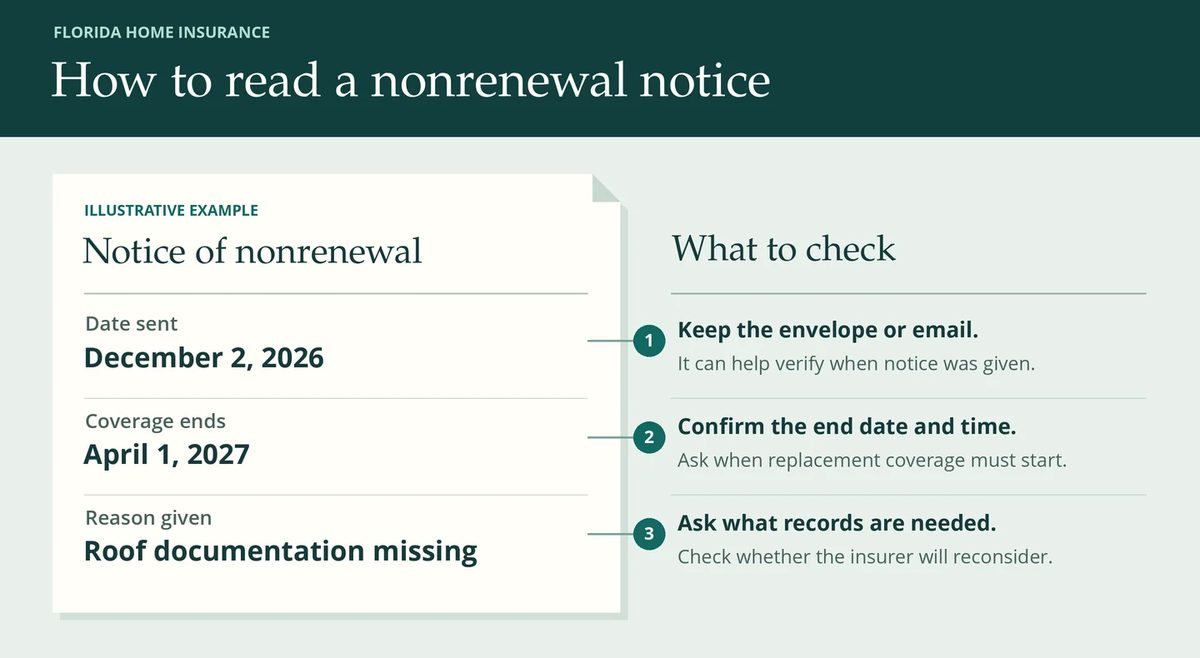
Write down the date sent, the effective date and time, and the insurer’s exact reason. Keep the envelope, email header or online delivery record, because the day you opened the letter may not be the day the insurer gave notice. Pull your declarations page, the policy summary showing the insurer, named insured, address, coverage limits and deductibles. If you bought through an agent, ask which company actually issued the policy and whether it is an admitted or surplus-lines insurer. The answer decides which row of the table below applies to you.
How much notice does Florida require before a non-renewal?
Florida requires at least 120 days’ written notice, with the reason, before an admitted insurer nonrenews a homeowners policy. Shorter periods apply to surplus-lines policies, missed payments, brand-new policies and a few special cases.
| What you received | Notice to look for |
|---|---|
| Nonrenewal of an admitted homeowners policy | At least 120 days, in writing, with the reason. |
| Nonrenewal of a surplus-lines policy | At least 45 days, in writing, with the reasons. Look for the surplus-lines disclosure on your policy. |
| Cancellation for nonpayment | At least 10 days, whether the policy is admitted or surplus lines. Call billing right away about the balance, the payment deadline and whether coverage is still in force. |
| Early cancellation of a new policy | Admitted: during the first 60 days, at least 20 days’ notice for reasons other than nonpayment. Surplus lines: the window is the first 90 days, with the same 20 days’ notice. Misrepresentation or failure to meet underwriting requirements can change that. |
| Citizens policy assumed by an authorized insurer offering replacement | At least 45 days for the Citizens nonrenewal notice in this situation. Check the offer and any separate response deadline. |
Two less common cases: a single policy covering both a home and a motor vehicle can be nonrenewed on 90 days’ notice (two separate policies with a bundle discount do not count), and the Office of Insurance Regulation can approve a plan that lets an insurer cancel or nonrenew early on 45 days’ notice. If your letter cites an exception, ask for the provision or order it relies on.
Florida Statutes § 627.4133(2) · Florida Statutes § 626.9201
What if the insurer gave you too little notice?
Late notice does not end your coverage on the insurer’s preferred date. Under § 627.4133(2), an admitted policy stays in force until the required notice period has run from the day notice was given or until replacement coverage starts, whichever comes first. The 10-day nonpayment notice is excluded from that protection. A surplus-lines policy stays in force until 45 days after notice or the start of replacement coverage. Ask the insurer for its notice record, the end date it recognizes and the premium due through that date, and keep shopping against the earliest date in dispute while you wait for a written answer. Florida’s insurance consumer helpline can help you challenge a notice. Contact Florida DFS at 877-693-5236.
Why do Florida insurers non-renew homeowners policies?
The notice has to state a reason, and the reason decides your next move. These are common ones in Florida.
- Roof age or condition. Florida law limits what an insurer can do on age alone (see the roof question below), but it can still act on condition, a missing permit or a short remaining life. Ask exactly which document would change the decision.
- A failed or outdated inspection. A four-point inspection covers the roof, electrical, plumbing and HVAC. Ask which item failed and whether a repair plus an updated report would be accepted.
- Claims history. Florida restricts using a single water claim or an act-of-God claim as the only reason (see the water-claim question). Several claims in a few years are treated differently, and they appear on the CLUE report the next insurer will pull.
- The insurer is pulling back. Carriers sometimes nonrenew whole groups of policies by county, distance to the coast or age of home to reduce their Florida exposure. Nothing you repair will reverse that, so put your time into replacement coverage.
- A change in how the home is used. Vacancy, renting the home out or short-term rental use can put it outside the insurer’s rules.
- Unrepaired damage or an open hazard. A tarped roof, unfinished repairs or a condition flagged at inspection.
If the reason is something you can fix, fix it and send proof while you shop. If it is not, go straight to your options.
Who will insure a Florida home after you’ve been dropped?
Florida homes are insured through three markets, and an agent who handles high-risk home insurance in Florida can check all three at the same time.
Admitted private insurers
These are carriers licensed in Florida. The Office of Insurance Regulation oversees their rates and policy forms, and the Florida Insurance Guaranty Association pays covered claims, within limits, if one fails. Start here. A home one carrier nonrenewed can still fit another carrier’s rules, especially once the roof or inspection question has a document behind it.
Citizens Property Insurance
Citizens is the state-created insurer for homes the private market will not insure at a comparable price. For a primary residence, an offer of comparable coverage from an authorized insurer priced at or below 120% of the Citizens premium generally makes the home ineligible. In most counties Citizens also cannot insure a home with a dwelling replacement cost of $700,000 or more (the limit is $1 million in Miami-Dade and Monroe), and its policies with wind coverage carry a flood insurance requirement, covered in the questions below. An agent can run the comparison and the other eligibility checks. Citizens eligibility law
Surplus-lines insurers
Surplus-lines insurers (also called excess and surplus, or E&S) take homes the first two will not: older roofs, prior claims, coastal exposure, high rebuilding costs, rentals, homes in the middle of a renovation. Since July 1, 2025, a Florida agent no longer has to collect rejections from admitted carriers before offering one, so ask for surplus-lines quotes alongside the others instead of waiting to be turned down.
Know the trade-offs before you bind:
- Florida’s guaranty fund does not pay claims if a surplus-lines insurer fails. Ask for the carrier’s financial strength rating and confirm your mortgage servicer accepts it.
- No Florida regulator approves surplus-lines rates or policy forms. Read the exclusions, the roof settlement terms and the wind or hurricane deductible, which can differ sharply from a standard policy.
- Notice periods are shorter: 45 days for nonrenewal, and a 90-day window for early cancellation.
- The premium includes a state surplus-lines tax and a service fee that an admitted policy does not carry.
Florida Statutes § 626.924, surplus-lines policy disclosures
For a home that admitted carriers and Citizens have turned away, a surplus-lines policy is often what keeps lender-placed insurance off your mortgage bill. It can also be a bridge: replace the roof or let an old claim age off, then move back to an admitted carrier. Expect to pay more than a standard policy; see how much more high-risk home insurance costs.
Need help comparing options for a Florida home? HighRiskHomeowners.com can connect you with a licensed insurance agent. Have the coverage end date and the reason from your letter handy.
A shopping timeline that protects your coverage date
Today, ask what would change the renewal decision
Call the number on your declarations page. For example, you might ask, “Your letter says roof documentation is missing. Which document would underwriting accept, where should I send it, and when can I expect a decision?” Record the name of the person you speak with. A request for reconsideration gives you a chance to correct the record. Keep shopping until the carrier confirms in writing that it will renew.
This week, give an agent the documents that answer the insurer’s question
- Send the nonrenewal notice and current declarations page through the licensed agent’s secure channel.
- For a roof issue, gather permits, final inspection records, paid invoices and any existing report that identifies roof condition and remaining useful life.
- For a prior loss, give the date, what was damaged, what was repaired and what remains open. Include receipts or completion photos you already have.
- For an inspection issue, ask which form and inspector the carrier accepts before paying for a new four-point or wind-mitigation inspection.
If you have only a few days, tell the agent the exact cutoff during the first call. Ask what can be reviewed today and which outstanding item could hold up binding. For a broader walkthrough, see what to do after an insurance nonrenewal.
While quotes are open, compare what each policy would pay
Price is one line of a quote. Ask every agent or carrier the same three questions so you are comparing like with like.
| Compare | Ask the agent |
|---|---|
| Dwelling and roof | What is the estimated rebuilding cost? For covered roof damage, does depreciation, a payment schedule or a separate roof deductible affect the settlement? |
| Wind and flood | Does this quote include wind? What is the hurricane deductible in dollars? Do I need a separate flood policy, and when would it start? |
| Water and living expenses | What limit or exclusion applies to a sudden plumbing leak? If a covered loss makes the home unlivable, how much temporary housing coverage is available? |
For example, a 2% hurricane deductible on a $450,000 dwelling limit is $9,000. At 5%, it is $22,500. That is another $13,500 you would have to absorb on a large enough covered hurricane loss. With the same insurer or insurer group, later covered hurricanes in the same calendar year generally use the greater of the remaining hurricane deductible or the all-other-perils deductible. Moving to an unrelated carrier can reset the hurricane deductible. Florida’s hurricane deductible guide
Before the current policy ends, confirm binding and lender acceptance
If you have a full notice period, aim to compare written offers about a month before expiration and follow up on outstanding conditions two weeks out. Those are planning targets. If your deadline is closer, do both now. A carrier may pause new binding as a storm approaches, so ask whether it can bind on the date you need.
Ask for written evidence that the new coverage is bound, and match its start time to the old policy’s end time. An application or price estimate still leaves that question open. If your mortgage is escrowed, confirm who will pay the first premium and when. Ask your servicer for its insurance-submission channel, exact mortgagee wording and acceptable proof. Send the binder, declarations page or other evidence it accepts and save its acknowledgment. Follow up on payment and any inspection or repair deadline the new carrier gives you. CFPB rules on lender-placed insurance and proof of coverage
What if your coverage ends during a hurricane or while repairs are underway?
For an admitted policy, a cancellation or nonrenewal scheduled to take effect during the legal duration of a hurricane is pushed to the end of that period. The clock starts when the National Hurricane Center issues a hurricane warning anywhere in Florida. It ends 72 hours after the last Florida hurricane watch or warning for that hurricane is lifted. A hurricane watch alone does not start the clock.
The insurer may charge premium for the extended time. The extension does not apply when replacement coverage has already been obtained and is in effect for a claim occurring during the hurricane. A tropical storm forecast, the start of hurricane season or news of a state of emergency does not move your deadline by itself. Ask the insurer for the effective time in writing. Florida’s hurricane definition · Hurricane extension under § 627.4133(2)(f)
A separate protection can matter for months after the weather clears. When hurricane or wind damage falls under both a qualifying emergency declaration and an insurance commissioner’s order, an authorized insurer cannot cancel or nonrenew until 90 days after the home is repaired. For other covered damage, the statute protects the property until the earlier of repair or one year after final claim payment. It also sets a 90-day notice rule for nonrenewal after repairs and allows specific exceptions, including nonpayment, claim fraud or material misstatement, unreasonable repair delays caused by the insured, or payment of policy limits. Send the claim number and repair status, and ask the carrier which provision and order govern your address. Florida insurance orders
Surplus-lines policies have a narrower version in § 626.9201. After the same kind of emergency declaration and commissioner’s order, a surplus-lines insurer cannot cancel or nonrenew a home damaged by that hurricane or wind event until 90 days after repairs, with similar exceptions. That statute has no one-year rule for other damage and no hurricane-duration extension, so ask the carrier in writing what happens if your end date falls during a storm. For preparation before a storm, see our guide to coastal home insurance and hurricane season.
Common questions about Florida homeowners insurance non-renewal
Is a non-renewal the same as a cancellation?
No. A non-renewal ends coverage on the policy’s expiration date. A cancellation ends the policy before that date. Once an admitted Florida policy has been in force more than 60 days, the insurer can cancel only for listed reasons such as nonpayment, a material misstatement or a substantial change in the risk. Either way, the date on the notice is the date to shop against.
Can the insurer drop me just because my roof turned 15?
On homeowners policies covered by Florida’s roof-age law, roof age alone cannot justify refusal to issue or renew when the roof is under 15. At 15 or older, you may pay for an inspection by an insurer-approved, qualified inspector before replacement is required. Five or more years of remaining useful life blocks an age-only refusal. Condition and other lawful underwriting reasons still matter. Mobile home policies are excluded from this statute. Florida roof-age protections
Can one water claim be the insurer’s only reason?
For a policy covered by § 627.4133(6), no, unless the insurer can show you failed to take a reasonable step it requested to prevent similar damage. The statute separately protects claims resulting from an act of God, with its own prevention exception. Keep the insurer’s requests and your repair records.
Will a non-renewal make it harder to get homeowners insurance in Florida?
It can, but usually less than a gap in coverage does. Applications ask whether a policy was canceled or nonrenewed and why, so answer accurately and keep the notice, because the stated reason matters. A non-renewal tied to the insurer’s own pullback, or to a roof you have since replaced, is easier for an agent to place than a home with a lapse in coverage. Keep the old policy in force until the new one is bound.
Should I report hurricane damage while shopping for a new policy?
Yes. Follow your current policy’s reporting instructions promptly. Florida DFS advises reporting hurricane wind damage even when it looks smaller than the deductible, so the insurer can record it toward a later qualifying loss that calendar year. Keep photos, estimates and receipts.
Will Citizens require me to buy flood insurance?
For affected Citizens personal residential policies with wind coverage, homes in FEMA special flood hazard areas must maintain qualifying flood coverage. Outside those areas, the 2026 threshold is $400,000 in dwelling replacement cost. Citizens directs homeowners to check their current Coverage A limit. The requirement reaches remaining affected homes January 1, 2027. Citizens lists exemptions for condominium unit-owner policies, tenant contents policies and policies excluding windstorm or hail. Citizens flood insurance schedule and exemptions
What if the mortgage company already bought insurance?
Ask its insurance department which dates it believes were uninsured. If your own policy covered that period, send evidence showing the dates and coverage. For a mortgage covered by the federal servicing rule, the servicer generally has 15 days after receiving qualifying evidence to cancel its force-placed policy and refund or remove charges for overlapping coverage. Our guide explains how force-placed home insurance works.
Who can help if the insurer and I disagree about the date?
For a notice dispute, contact the Florida Department of Financial Services at 877-693-5236 in Florida or 850-413-3089 from outside Florida. Have the notice, delivery record and insurer’s written response ready. For replacement coverage, a licensed agent can review the home while you pursue that question.
Get help finding replacement coverage in Florida
If the letter is on your kitchen table now, your first call can be simple. Give the agent the date coverage ends, the reason on the notice and any repairs already completed. Ask which options can be reviewed before your deadline and what the agent needs from you today.
HighRiskHomeowners.com is a referral service that connects homeowners with licensed insurance agents. It is not an insurance company or agency. Coverage and eligibility depend on the home, insurer and policy. This guide provides general information. Your carrier or agent can confirm in writing when a policy starts or ends.